
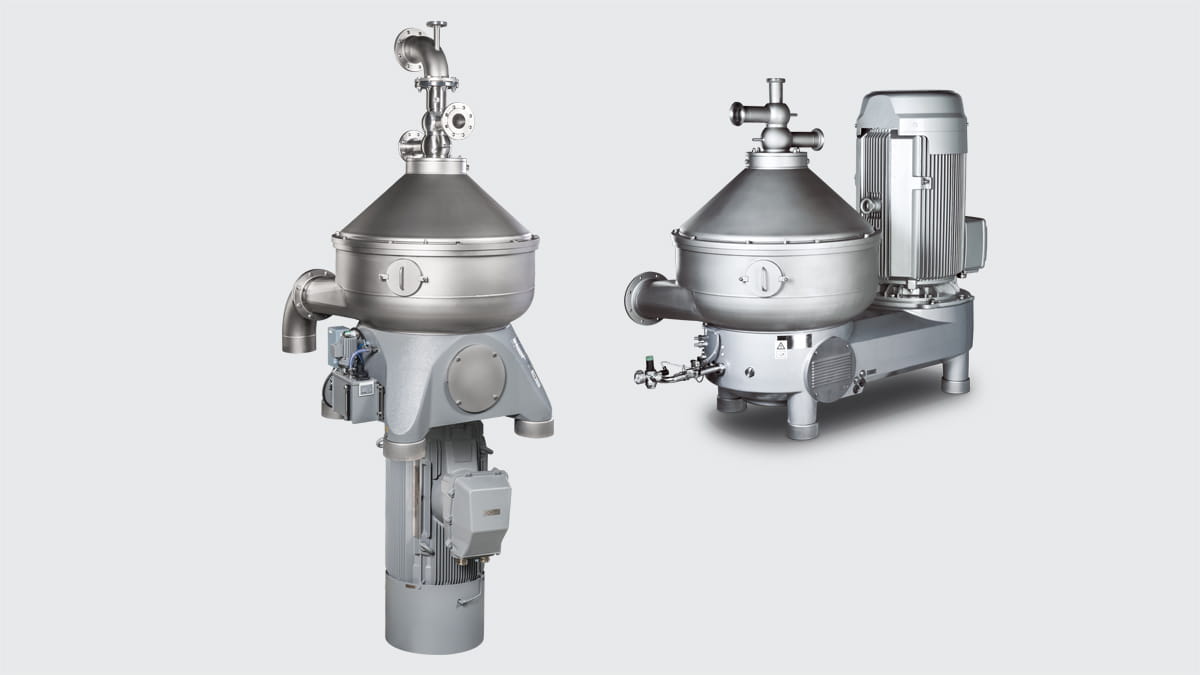
Naturalmente, i nostri separatori a ugelli sono compatibili con il lavaggio CIP e sono progettati per fornire la massima portata, i minori consumi e la massima disponibilità. L'azionamento diretto opzionale restituisce portate maggiori con il medesimo apporto energetico, rumorosità inferiore, impatto minore e minori costi d'esercizio grazie alla minor quantità di componenti e la facile manutenzione.
Inoltre, la sostituzione degli ugelli richiede pochi minuti grazie alla loro accessibilità e avviene dall'esterno attraverso un dotto: non è necessario smontare il coperchio o il tamburo.
Caratteristiche e vantaggi
- Acqua di processo eccellente riduce al minimo il consumo di acqua fresca
- Alimentazione continua e stabile mediante l'unità HC, agevolando il lavaggio
- Massime prestazioni con manutenzione minima
- Nessuna perdita di qualità dell'amido grazie all'alimentazione e allo scarico chiusi (è impossibile che l'amido si ossidi)
- Bassi consumi energetici grazie all'azionamento moderno e alla speciale configurazione degli ugelli
- Lavaggio CIP alla velocità operativa
- Nessuna pompa aggiuntiva per la fase liquida grazie alla pompa centripeta interna
- Manutenzione rapida e semplice grazie alla straordinaria accessibilità degli ugelli
Vantaggi supplementari dei separatori dotati di azionamento diretto:
- Maggiore portata con il medesimo dispendio energetico
- Costi d'esercizio ridotti (nessun riduttore, sostituzione degli accoppiamenti semplice e diretta)
- Rumorosità relativamente bassa
- Eventuali guasti agli accoppiamenti o al motore non possono causare danni
- Nessun tensionamento della cinghia
- Ingombri ridotti
Capacità
Portata di alimentazione nominale: da 40 a 500 m³/hWhat is a starch separator?
A starch separator is a high-speed disk-stack centrifuge that uses high g-force to separate starch granules from water, fibers, proteins and other dissolved substances. In industrial starch processing, GEA nozzle separators are the standard solution because they can handle high volumes and have a very high separation efficiency.
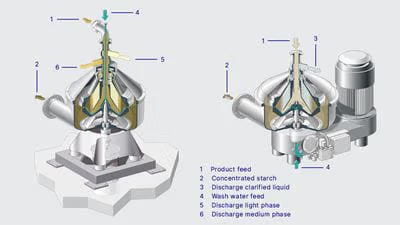
Working principle of a 2-phase and a 3-phase nozzle separator for starch concentration and washing
What are the main applications of starch separators?
GEA nozzle separators are used across the food industry wherever starch must be recovered, washed or concentrated, and corn gluten must be thickened. Typical applications include wheat starch, corn (maize) starch, potato starch, tapioca starch, rice and pea starch productions.
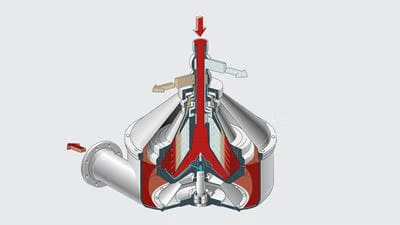
How does a GEA separator for starch recovery work?
The product enters the bowl, is accelerated and passes into the disk-stack, where centrifugal force separates the starch particles from the liquid. The narrow gaps between the disks reduce the settling distance and provide a large clarification area.
Features & Benefits of GEA starch separators
- Excellent process water quality minimizing fresh water consumption
- Continuous and stable feed to the HC unit for uncomplicated washing
- Closed feed and discharge prevent foaming and make for a more stable overall production process
- Low energy consumption because of modern drive concepts, special nozzle configuration and reduced bowl weight
- Automatic CIP included
- No additional pumps for the liquid phase because of internal centripetal pump
- Fast and easy maintenance due to excellent access to the nozzles
Extra advantages of starch separators with direct drive
- Higher capacity with same energy input
- Retroactive capacity adjustments by using different motor sizes
- Reduced service efforts (no gearbox, coupling replacement is direct and simple)
- No belt tensioning
- Only very little space required due to small footprint
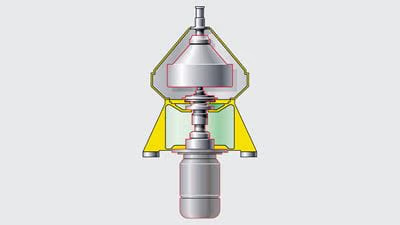
Starch separators with direct drives
More performance, less complexity
GEA’s separation expertise and portfolio for starch recovery
Depending on the specific feedstock, i.e. wheat, corn, rice etc., GEA offers disk-stack nozzle separators in 2-phase or 3-phase design, with or without integrated wash water systems, with flatbelt or direct drive.
Our expertise covers not only single machines but the entire wet process engineering, including rotary brush strainers, pumps, valves, control cabinets, piping and the entire skid production process—from design and drafting to planning and completion.
Apart from nozzle separators GEA also offers self-cleaning separators for process water clarification and decanter centrifuges for dewatering or separation purposes.
How does the GEA nozzle separator compare to other starch separation technologies?
|
Technology |
Primary job |
Where it fits |
|
Nozzle separator (GEA) |
Continuous washing & concentrating of starch; corn gluten thickening |
Main workhorse in industrial starch processing |
|
Clarifying decanter |
Dewatering of solids with higher solids content |
Sludge / fiber-rich streams, pre- or post-stages |
|
Hydrocyclone (HC) unit |
Multi-stage countercurrent washing of starch |
Fine washing between separator stages |
|
Disk-stack clarifier |
Polishing / removing fine solids from low-solid streams |
Process water clarification |
Nozzle separators and hydrocyclones are typically used together: the separator concentrates, the HC unit washes, on top GEA nozzle separators make for a continuous, stable feed to the HC unit.
Capacity & Technical Specifications
GEA nozzle separators cover a rated feed flow capacity of 20 to 400 m³/h, allowing the machine to be sized precisely to each starch separation stage, from corn gluten thickening to primary starch concentration in large-scale plants.
Direct-drive separators can easily be equipped with motors of different sizes, making the separator suitable for a wider range of throughput capacities and starch concentrations.
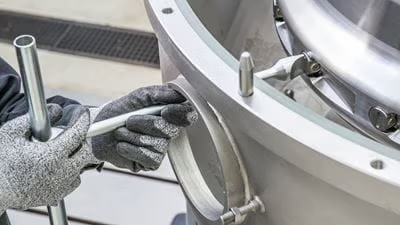
Easy access for fast nozzle replacement
The bowl is designed for high g-force and continuous nozzle discharge, with nozzles accessible from the outside through a duct for fast replacement. The nozzles are locked in place automatically and help save energy due to the way their product discharge is oriented: opposite to the direction of the bowl's rotation.
Drive options include a belt drive and an optional direct drive. Product-contact parts are built for hygienic operation in food processing and are CIP-capable.
How is the separator cleaned and maintained?
The separator is fully CIP-capable. During the automatic CIP cycle, the bowl is sped up to maximum speed to create a ring of CIP liquid inside the bowl. The speed is then reduced which causes the liquid ring to collapse. This leads to high splashing and turbulence so that every corner and every spot is wetted and thus cleaned.
GEA offers regular drive and bowl maintenance through its International Service and Repair Network.
What service and support does GEA provide?
GEA supports the full lifecycle of every nozzle separator through its International Service and Repair Network, original spare parts, performance upgrades, automation & controls packages, and Remote Factory Acceptance Tests (Remote FATs). On-site service and condition monitoring help maintain availability over the long service life of the machine.
Our portfolio of digital products for centrifugal separators and decanter centrifuges delivers a connected ecosystem of monitoring, optimization and service solutions.
Combining equipment data, advanced analytics and expert support, our digital solutions enable higher transparency, faster decision-making and continuous operational improvement.
With our 24/7 monitoring solution for your GEA separators and decanters - GEA InsightPartner® Separation Monitoring - you benefit from early issue detection, automated analysis and expert remote support for increased availability, reliability and efficiency.
Frequently Asked Questions about nozzle separators from GEA for starch recovery
The required capacity depends on raw-material throughput, the number of washing stages and the target starch quality. GEA sizes each separator individually based on your mass balance, request a quote for a stage-by-stage recommendation.
Because the nozzles are accessible through an external duct in the catcher you do not have to dismantle the hood and all the piping. Thus, nozzle exchange is relatively fast compared to other starch separators without ducts.
GEA nozzle separators are designed for long service life under continuous industrial operation. The lifetime can be extended significantly through original spare parts and regular service inspections from GEA's International Service and Repair Network.
Yes. GEA offers upgrade packages, updated automation & controls, and refurbishment through its International Service and Repair Network, designed to improve capacity, energy efficiency and uptime on installed equipment.
Downloads
Prodotti correlati

Decanter di chiarificazione per il recupero dell'amido
Per il recupero dell'amido vengono installati decanter di chiarificazione in varie fasi del processo, a seconda del materiale grezzo.

Automation & Controls Separation
Even the best centrifuges cannot function optimally if they are not partnered with control systems of equal quality. For their range of separators and decanters, GEA offers standardized as well as tailor-made solutions for machine automation with many features to meet customer requirements.

3-phase wheat starch decanters
GEA starchmaster CF decanter series for the extraction of wheat starch - efficient, robust, yield-optimized


Video correlati
Let’s get connected – digital solutions for GEA centrifuges
Let’s get connected – digital solutions for GEA separators and decanters
Stay stronger with GEA Service Level Agreements
Approfondimenti GEA
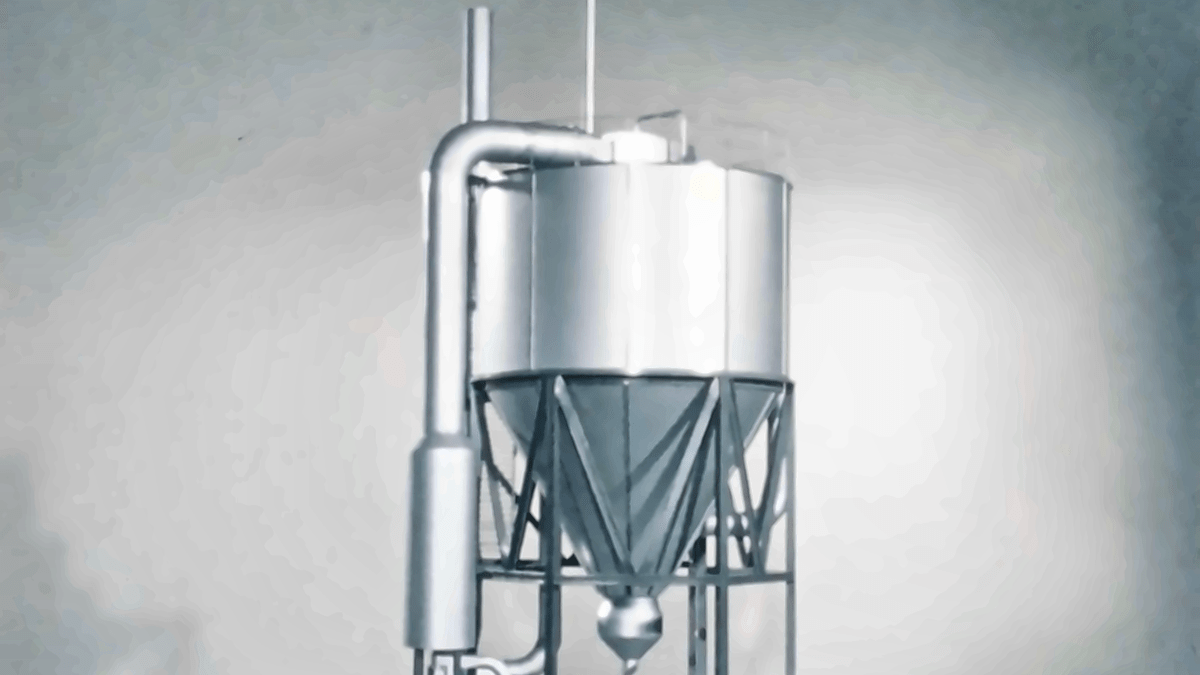
La svolta che ha rivoluzionato lo spray drying
Nel 1976, gli ingegneri di NIRO risposero a una sfida della concorrenza ripensando radicalmente le potenzialità dello spray drying. Da questa intuizione nacque l'essiccatore multistadio MSD. Cinquant'anni dopo, lo stesso principio fondamentale contribuisce a trasformare i liquidi nelle polveri utilizzate in prodotti nutrizionali essenziali e in importanti farmaci in tutto il mondo. Perfezionato grazie a decenni di competenza ingegneristica, attenzione alle esigenze dei clienti e sviluppo continuo, l'MSD rappresenta una storia di innovazione dall'impatto duraturo.

Oltre le macchine: come migliorare le prestazioni dell’impianto
Una macchina efficiente non garantisce automaticamente l'efficienza di uno stabilimento. Il vero miglioramento spesso inizia guardando oltre le singole attrezzature e comprendendo come i processi, i sistemi energetici e le decisioni operative si influenzino a vicenda. Si tratta di un approccio olistico pensato per individuare opportunità che altrimenti potrebbero sfuggire.

Come una valvola rivoluziona la produzione di alimenti e bevande
Negli impianti di produzione di alimenti e bevande, le valvole vengono solitamente azionate tramite aria compressa. GEA Hydract® Actuation Technology utilizza l'acqua all'interno di un circuito chiuso e controllato digitalmente. Il risultato è una valvola che può essere mantenuta esattamente in posizione e regolata con per piccoli incrementi con grande precisione. Ciò si traduce in un minor consumo energetico e in un maggiore controllo.
