
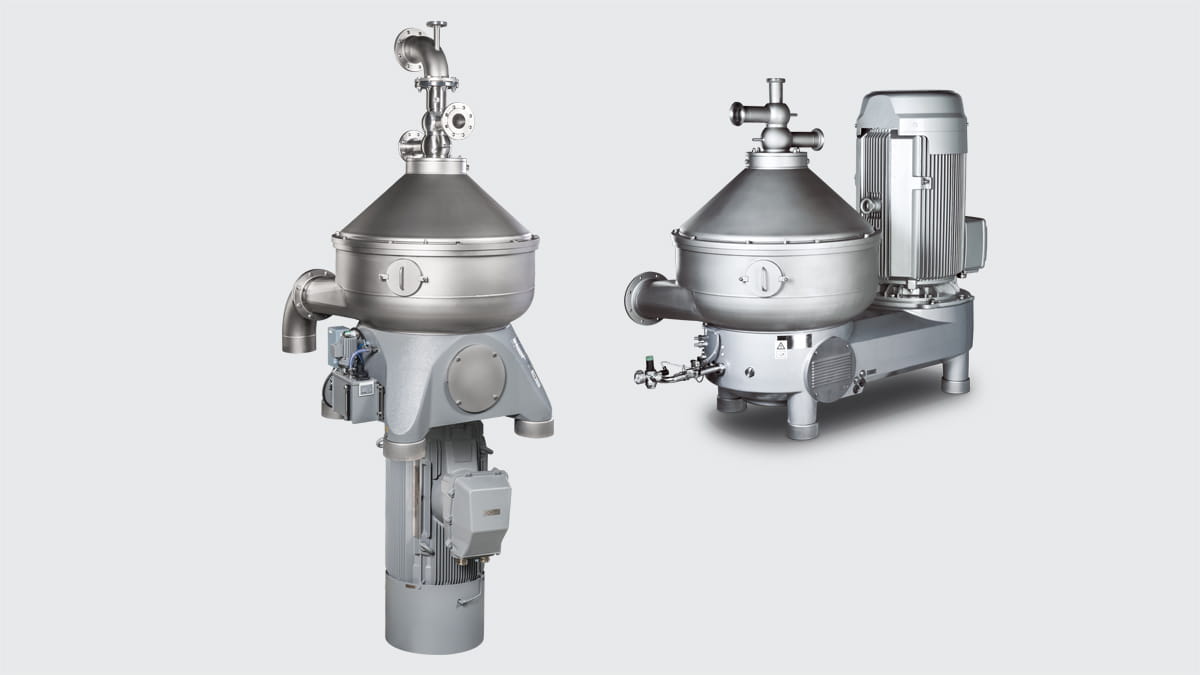
Nos séparateurs à buses, qui sont bien sûr tous dotés de fonctions NEP, sont conçus pour offrir une capacité maximale, une consommation d'énergie minimale et une disponibilité maximale. L'entraînement direct en option permet d'obtenir une capacité supérieure sans augmenter la consommation d'énergie, un niveau de bruit plus bas, un encombrement réduit ainsi que des coûts d'entretien inférieurs puisque la machine comporte moins de pièces et que son entretien est simple.
De plus, remplacer une buse est l'affaire de quelques minutes car les buses sont faciles d'accès et simples à remplacer depuis l'extérieur via un conduit pratique : il est inutile de démonter le capot ou le bol.
Caractéristiques et avantages
- Une eau de procédé excellente minimise la consommation d'eau fraîche
- Alimentation continue et stable de l'unité HC pour un nettoyage simple
- Performances maximales assorties d'un entretien minimal
- Pas de perte de qualité de l'amidon car l'alimentation et l'évacuation sont fermées (pas de risque d'oxydation de l'amidon)
- Faible consommation d'énergie grâce aux solutions d'entraînement pointues employées et à la configuration particulière des buses
- Nettoyage NEP à la vitesse de fonctionnement
- Pas de pompes supplémentaires pour la phase liquide puisqu'il y a une pompe centripète interne
- Entretien rapide et simple favorisé par les buses facilement accessibles
Avantages supplémentaires des séparateurs à entraînement direct :
- Capacité accrue sans augmentation de la consommation d'énergie
- Coûts d'entretien réduits (pas de boîte à engrenages, le remplacement de l'accouplement est simple et direct)
- Le niveau de bruit est relativement bas
- Les pannes du moteur ou de l'accouplement ne peuvent pas provoquer de dommages
- Pas de courroie à tendre
- Ils occupent très peu de place grâce à leur encombrement réduit
Capacité
Alimentation nominale : de 40 à 500 m³/hWhat is a starch separator?
A starch separator is a high-speed disk-stack centrifuge that uses high g-force to separate starch granules from water, fibers, proteins and other dissolved substances. In industrial starch processing, GEA nozzle separators are the standard solution because they can handle high volumes and have a very high separation efficiency.
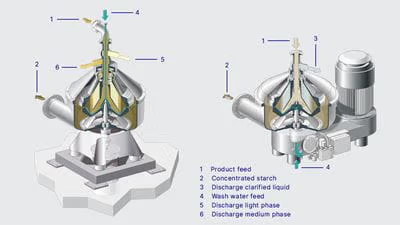
Working principle of a 2-phase and a 3-phase nozzle separator for starch concentration and washing
What are the main applications of starch separators?
GEA nozzle separators are used across the food industry wherever starch must be recovered, washed or concentrated, and corn gluten must be thickened. Typical applications include wheat starch, corn (maize) starch, potato starch, tapioca starch, rice and pea starch productions.
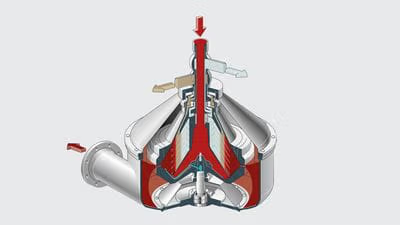
How does a GEA separator for starch recovery work?
The product enters the bowl, is accelerated and passes into the disk-stack, where centrifugal force separates the starch particles from the liquid. The narrow gaps between the disks reduce the settling distance and provide a large clarification area.
Features & Benefits of GEA starch separators
- Excellent process water quality minimizing fresh water consumption
- Continuous and stable feed to the HC unit for uncomplicated washing
- Closed feed and discharge prevent foaming and make for a more stable overall production process
- Low energy consumption because of modern drive concepts, special nozzle configuration and reduced bowl weight
- Automatic CIP included
- No additional pumps for the liquid phase because of internal centripetal pump
- Fast and easy maintenance due to excellent access to the nozzles
Extra advantages of starch separators with direct drive
- Higher capacity with same energy input
- Retroactive capacity adjustments by using different motor sizes
- Reduced service efforts (no gearbox, coupling replacement is direct and simple)
- No belt tensioning
- Only very little space required due to small footprint
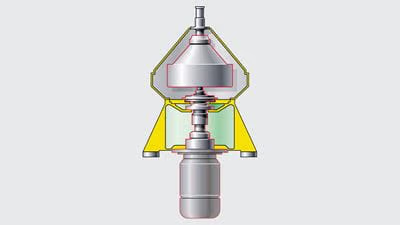
Starch separators with direct drives
More performance, less complexity
GEA’s separation expertise and portfolio for starch recovery
Depending on the specific feedstock, i.e. wheat, corn, rice etc., GEA offers disk-stack nozzle separators in 2-phase or 3-phase design, with or without integrated wash water systems, with flatbelt or direct drive.
Our expertise covers not only single machines but the entire wet process engineering, including rotary brush strainers, pumps, valves, control cabinets, piping and the entire skid production process—from design and drafting to planning and completion.
Apart from nozzle separators GEA also offers self-cleaning separators for process water clarification and decanter centrifuges for dewatering or separation purposes.
How does the GEA nozzle separator compare to other starch separation technologies?
|
Technology |
Primary job |
Where it fits |
|
Nozzle separator (GEA) |
Continuous washing & concentrating of starch; corn gluten thickening |
Main workhorse in industrial starch processing |
|
Clarifying decanter |
Dewatering of solids with higher solids content |
Sludge / fiber-rich streams, pre- or post-stages |
|
Hydrocyclone (HC) unit |
Multi-stage countercurrent washing of starch |
Fine washing between separator stages |
|
Disk-stack clarifier |
Polishing / removing fine solids from low-solid streams |
Process water clarification |
Nozzle separators and hydrocyclones are typically used together: the separator concentrates, the HC unit washes, on top GEA nozzle separators make for a continuous, stable feed to the HC unit.
Capacity & Technical Specifications
GEA nozzle separators cover a rated feed flow capacity of 20 to 400 m³/h, allowing the machine to be sized precisely to each starch separation stage, from corn gluten thickening to primary starch concentration in large-scale plants.
Direct-drive separators can easily be equipped with motors of different sizes, making the separator suitable for a wider range of throughput capacities and starch concentrations.
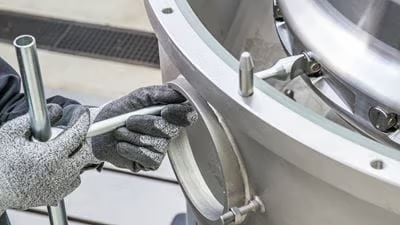
Easy access for fast nozzle replacement
The bowl is designed for high g-force and continuous nozzle discharge, with nozzles accessible from the outside through a duct for fast replacement. The nozzles are locked in place automatically and help save energy due to the way their product discharge is oriented: opposite to the direction of the bowl's rotation.
Drive options include a belt drive and an optional direct drive. Product-contact parts are built for hygienic operation in food processing and are CIP-capable.
How is the separator cleaned and maintained?
The separator is fully CIP-capable. During the automatic CIP cycle, the bowl is sped up to maximum speed to create a ring of CIP liquid inside the bowl. The speed is then reduced which causes the liquid ring to collapse. This leads to high splashing and turbulence so that every corner and every spot is wetted and thus cleaned.
GEA offers regular drive and bowl maintenance through its International Service and Repair Network.
What service and support does GEA provide?
GEA supports the full lifecycle of every nozzle separator through its International Service and Repair Network, original spare parts, performance upgrades, automation & controls packages, and Remote Factory Acceptance Tests (Remote FATs). On-site service and condition monitoring help maintain availability over the long service life of the machine.
Our portfolio of digital products for centrifugal separators and decanter centrifuges delivers a connected ecosystem of monitoring, optimization and service solutions.
Combining equipment data, advanced analytics and expert support, our digital solutions enable higher transparency, faster decision-making and continuous operational improvement.
With our 24/7 monitoring solution for your GEA separators and decanters - GEA InsightPartner® Separation Monitoring - you benefit from early issue detection, automated analysis and expert remote support for increased availability, reliability and efficiency.
Frequently Asked Questions about nozzle separators from GEA for starch recovery
The required capacity depends on raw-material throughput, the number of washing stages and the target starch quality. GEA sizes each separator individually based on your mass balance, request a quote for a stage-by-stage recommendation.
Because the nozzles are accessible through an external duct in the catcher you do not have to dismantle the hood and all the piping. Thus, nozzle exchange is relatively fast compared to other starch separators without ducts.
GEA nozzle separators are designed for long service life under continuous industrial operation. The lifetime can be extended significantly through original spare parts and regular service inspections from GEA's International Service and Repair Network.
Yes. GEA offers upgrade packages, updated automation & controls, and refurbishment through its International Service and Repair Network, designed to improve capacity, energy efficiency and uptime on installed equipment.
Downloads
Produits associés

Clarifying Decanters for Starch Recovery
For starch recovery clarifying decanters are installed in different process stages depending on the raw material.

Automation & Controls Separation
Even the best centrifuges cannot function optimally if they are not partnered with control systems of equal quality. For their range of separators and decanters, GEA offers standardized as well as tailor-made solutions for machine automation with many features to meet customer requirements.

3-phase wheat starch decanters
GEA starchmaster CF decanter series for the extraction of wheat starch - efficient, robust, yield-optimized
Prestations de services

Réseau de réparation international pour les centrifugeuses GEA
Réparations correctives pour vos séparateurs et décanteurs GEA

ERU à distance pour centrifugeuses GEA
Il n'est pas possible d’effectuer l’essai de réception en usine (ERU) de votre centrifugeuse sur le site à cause des restrictions aux voyages actuelles, d’un emploi du temps très chargé ou d’une autre raison urgente ? Vous avez l’habitude de toujours rechercher des manières de rendre vos processus métiers plus digitaux, de réduire considérablemen...
Vidéos associées
Let’s get connected – digital solutions for GEA centrifuges
Let’s get connected – digital solutions for GEA separators and decanters
Stay stronger with GEA Service Level Agreements
GEA Insights
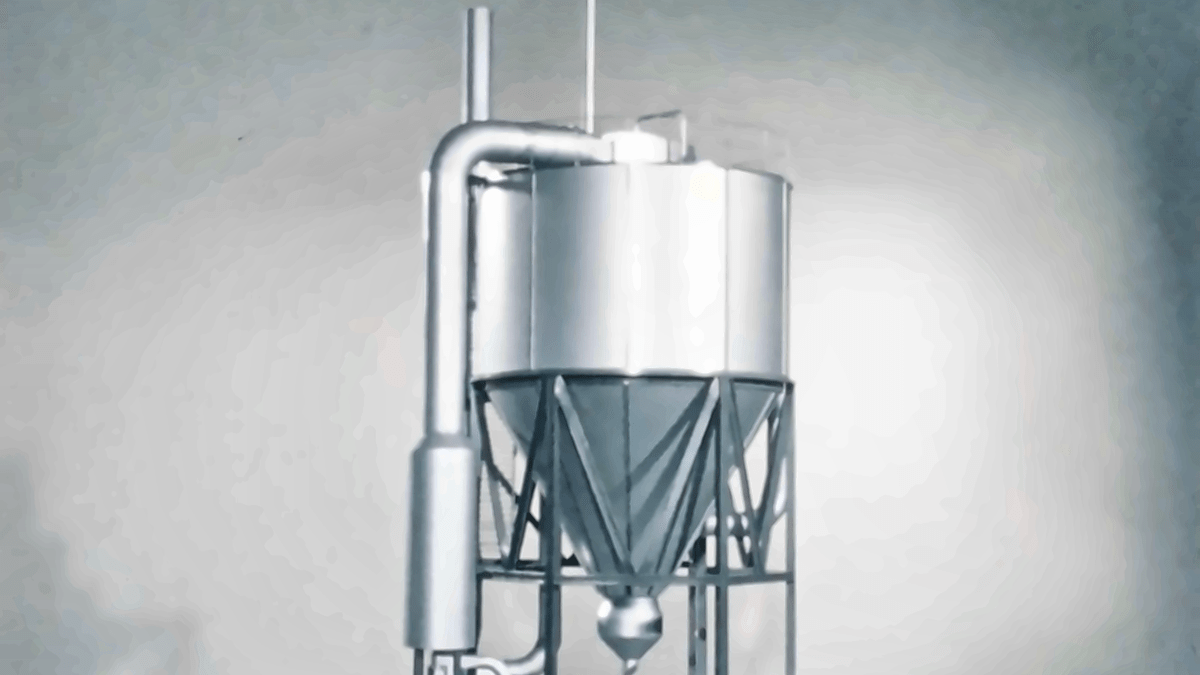
La percée qui a révolutionné le séchage par atomisation
En 1976, les ingénieurs de NIRO répondaient à un défi concurrentiel en repensant ce que pouvait faire le séchage par atomisation. Leur idée est à l'origine du sécheur-atomiseur à plusieurs étages MSD. Cinquante ans plus tard, ce même principe fondamental aide à transformer les liquides en poudres, qui sont utilisées dans des produits nutritionnels essentiels et des médicaments importants partout dans le monde. Perfectionné au cours de plusieurs décennies d'expertise technique, d'enquêtes clientèle et de développement continu, le MSD est une histoire d'innovation aux retombées durables.

Au-delà des machines : exploiter les gisements de performance des installations
Ce n'est pas parce que vous avez des machines efficaces que votre usine l'est. Une trajectoire d'amélioration efficace commence souvent par une analyse qui ne se limite pas aux équipements pris individuellement, et cherche à comprendre comment les processus, les systèmes énergétiques et les décisions opérationnelles s'influencent mutuellement. C'est une démarche holistique, conçue pour repérer des opportunités qui, sans cela, risqueraient de passer inaperçues.

Comment une vanne révolutionne la production des aliments et des boissons
Dans les installations agroalimentaires, les vannes sont généralement actionnées en utilisant de l'air comprimé. La technologie d'actionnement GEA Hydract® Actuation Technology, quant à elle, actionne les vannes en utilisant de l'eau, au sein d'un circuit fermé à commande numérique. Résultat, une vanne peut être maintenue en place de manière exacte et réglée par petits paliers. Cela se traduit par une consommation d'énergie en baisse et un meilleur contrôle.
