

Protein demand is reshaping the value of whey
Global demand for protein ingredients is opening new opportunities for dairy producers. Yet cheese whey is still often sold or used in lower-value applications.
Processing whey further can turn an existing production stream into a source of protein ingredients, new products and new markets. The question is what to produce, which process is right for your whey and how to build a setup that makes commercial sense.
GEA can help you answer those questions.


There’s more value to unlock
Whey can be processed at different levels, with each step opening up new products, applications and value. See where you are today – and discover what could be possible with the next step in your whey journey.
More than equipment. Expertise you can build on.
Turning a whey opportunity into a successful production setup takes experience as well as technology. GEA brings decades of dairy expertise and deep knowledge of whey applications and processing.
We can help you evaluate options, test processes and validate the route forward before you commit to full-scale production. As your plans develop, our expertise spans process design, equipment, plant integration and scale-up.
From first assessment to commercial production, you have a partner who understands both the process and what you want to achieve.
From whey processing to whey protein production
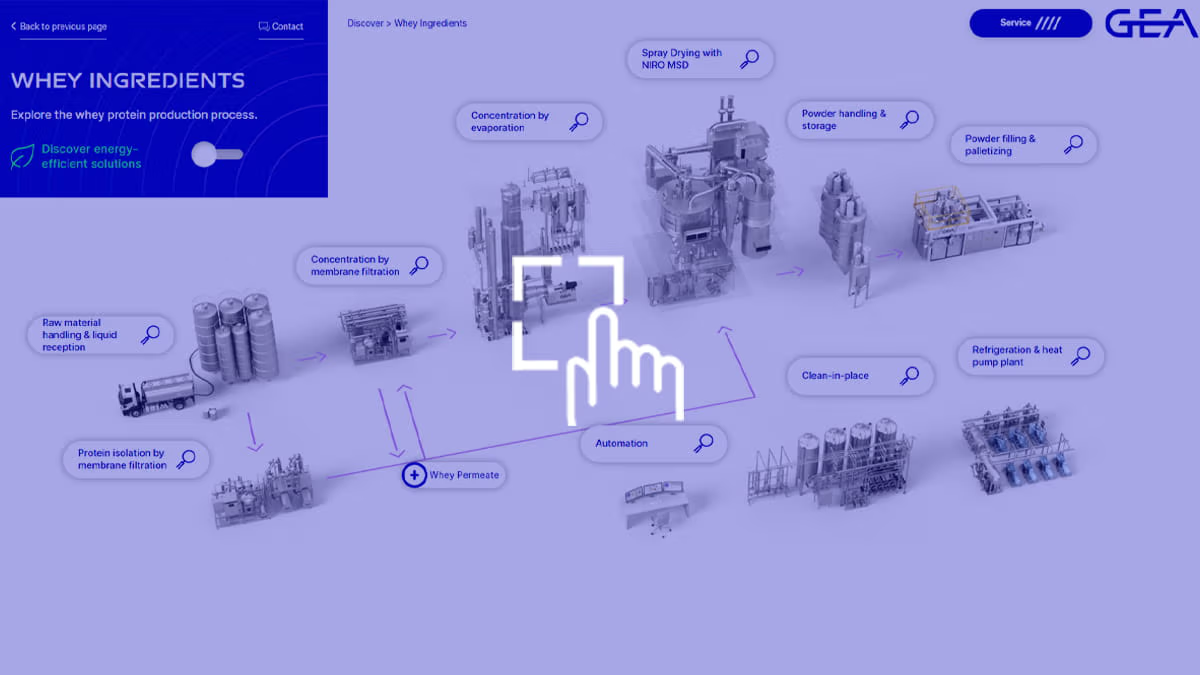
Producing whey protein at commercial scale requires a carefully designed sequence of processing steps. Starting with whey separation and clarification, membrane filtration can be used to concentrate and refine the protein stream. Further concentration, evaporation and drying then prepare the product for storage, transport and use as an ingredient.
The technologies, configuration and capacity of the production line will depend on the whey stream, target product and required quality. GEA brings these technologies together in integrated whey processing plants and production lines designed for efficient, reliable production at scale.


The process behind whey protein
Explore the whey protein production process
Calculate the potential
How much potential is flowing through your plant today? Enter a few details about your current whey stream to get an initial estimate of what further processing could mean for your operation.
GEA & Yili D90 demineralized whey powder project success story
Yili and GEA partnered to establish China’s first full electrodialysis integrated D90 demineralized whey production line, transforming whey into a high-value ingredient for infant formula production.
Products & technologies
Showing 4 of 7

Automatic Powder Fillers
Our Inline Automatic Filler range has been designed to provide a flexible powder filling solution to suit plants which may need to increase production capacity to meet future demand.
The Inline Filler range comprises a single head model (IBF-450) that can be upgraded to include a single top-up system (IBF-600) or dual top-up system (IBF-800) to ...

Bag/Sack Powder Fillers
Our range of multi-wall bag/sack fillers is designed to pack powdered products at rates of less than 1 tonne/h up to more than 12 tonnes/h with an accuracy better than 10 g (0.35 oz). Our extensive experience with a wide range of powdered products and packaging types means that we can provide a solution to meet the most demanding powder filling r...

Box & Drum Powder Fillers
The choice of packaging format is often driven by a consumers needs. GEA understands the requirement for a flexible system to handle a wide range of packaging types. To meet this need, we have developed a range of solutions to handle flexible bags, boxes and drums for powder filling applications.

Centrifugal Separator
GEA separators are designed for liquid-based applications. Using centrifugal force, they are used for separating suspensions consisting of two or more phases of different densities, i.e. they can be used for liquid-liquid separation, for liquid-liquid-solid separation or for liquid-solid separation. They are equally as effective at separating liq...
GEA Insights


The water equation
Across Europe, drought is a recurring reality – and no longer confined to the south. While water increasingly shapes where industries locate, its value is determined by local context. There are many technological routes to water efficiency in industrial processes, but location, energy needs and other factors are also key.
