
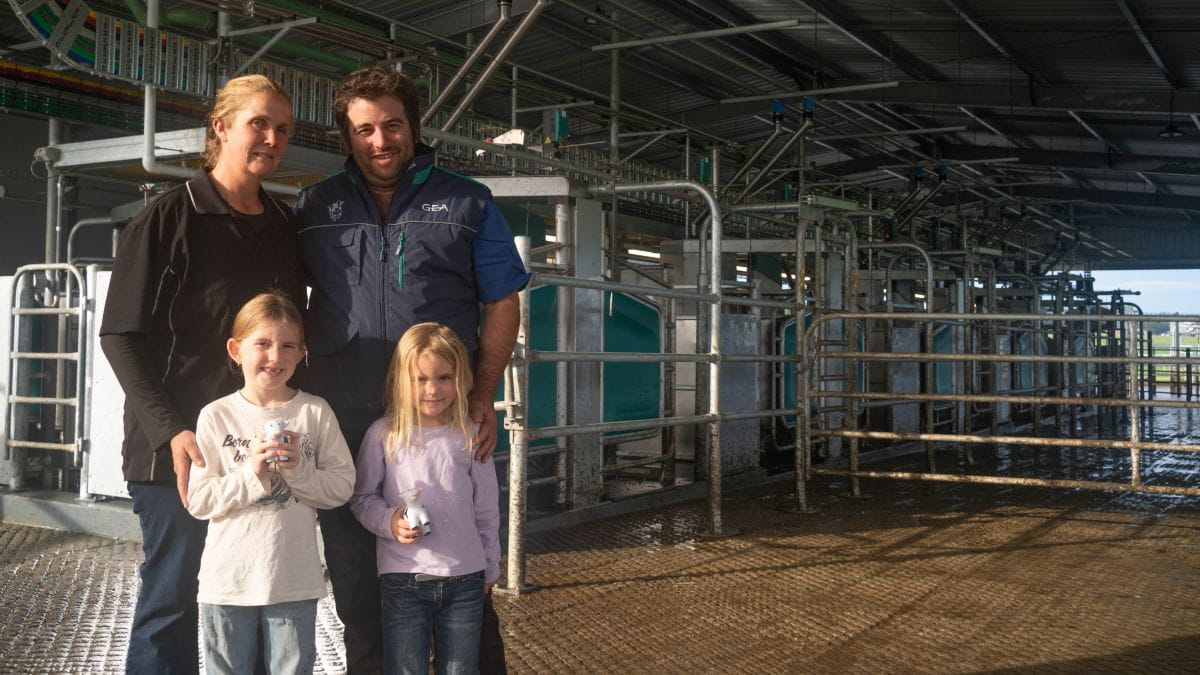
For Dennis and Erin Lomax, moving from a traditional rotary dairy to robotic milking was about much more than changing how cows are milked.
At their farm in Valencia Creek, Victoria, the family now milks around 580 cows using 10 GEA DairyRobot units, supported by voluntary cow flow and CowScout herd monitoring. The change has given the family greater flexibility while providing more information to help manage individual cows and the wider herd.
“With GEA’s robots, we’re no longer tied to the dairy morning and afternoon. The cows choose when they’re milked, and the data helps us make faster management decisions.”
Dennis and Erin Lomax, Valencia Creek, Victoria
Building the Dairy Around the Farm
When the Lomax family began planning their move to robotic milking, the starting point was not simply the technology.
Cow flow and people flow were among the first considerations. The property was well suited to three-way grazing, with irrigation available across parts of the farm. Several design concepts were explored before arriving at a layout intended to meet the farm’s practical requirements.
The original concept was based on eight robots milking around 500 cows. As the project developed, the design expanded to 10 robots to provide capacity aligned with what the available land could support.
GEA worked with local GEA dealer Future Dairies Gippsland and Dennis during the early design process and provided technical support through the project, commissioning and start-up. Herd-management support has continued after commissioning to help the farm use the information available through the system.
More Flexibility for the Whole Family
One of the clearest changes has been the freedom to organise family life differently.
For Dennis, that flexibility is something very practical:
“Now that we have the GEA setup, we can all leave. Before, it would usually be me and the kids going to events. Now Erin can come too.”
That difference matters to a family with two daughters, Millie and Hazel. Instead of the daily routine being defined entirely by fixed morning and afternoon milking sessions, automated milking creates greater flexibility around when the family needs to be at the dairy.
For the Lomax family, automation is therefore not simply about reducing physical work. It is helping create a different way of organising the farm and family routine.
Letting the Cows Choose
The move to voluntary milking has also changed how the cows interact with the dairy.
Rather than the entire herd being brought to the dairy for fixed milking sessions, cows can move through the system voluntarily.
Erin has noticed the difference:
“The cows seem happier and healthier because they can do it as they please. We’re not pushing them all the time.”
The Lomax system combines robotic milking with a pasture-based grazing operation, making cow movement, feed management and farm layout important parts of the overall system.
The experience at Lomax demonstrates an important principle for automated milking: the robot is only one part of the solution. The whole farm needs to work around the movement of cows, people, feed and information.
Turning Cow Data Into Better Decisions
Automation has also given Dennis greater visibility of what is happening with individual cows.
“The information is pretty good. We can see what every cow is doing, identify high cell count cows and make management decisions much faster.”
Dennis Lomax
GEA DairyRobot and herd-management technology provide information that can support daily herd-management decisions. CowScout adds behavioural monitoring, including activity, eating and rumination information, while GEA’s herd-management tools are designed to turn cow and herd data into actionable insights.
For Dennis, access to this level of information has become an important part of managing the new system. Internal project feedback noted both the amount of information available and the time Dennis spends analysing the data to understand the herd.
The benefit is not simply more data.
It is the ability to use that information to identify which cows may need attention and make informed management decisions sooner.
A Transition, Not the Push of a Button
Moving from rotary milking to a voluntary robotic system required adjustment for both the cows and the people working with them.
The Lomax dairy started with 350 cows across the 10 robots shortly before winter. Wet conditions, longer nights and slower grass growth contributed to some of the challenges involved in establishing voluntary cow movement through the new system.
That experience is an important part of the Lomax story.
Automated milking can deliver new flexibility and information, but creating a system that performs for an individual farm requires planning, good farm management, realistic preparation and support through start-up.
For the Lomax family, the transition has been a learning process rather than an overnight transformation.
Local Support Behind the System
The Lomax system was installed by Future Dairies Gippsland, with ongoing local support from Westfalia Warragul and GEA.
GEA provided design and technical support during development, installation, commissioning and start-up, with ongoing herd-management support also provided after the system entered operation.
That combination of farm knowledge, local dealer capability and specialist automated-milking and herd-management support is particularly important when moving from an established milking routine to a completely different operating model.
Your Farm. Your Cows. Your Next Step.
The Lomax story shows what automated milking can make possible for one Australian dairy family.
But every farm is different.
The right next step may be upgrading an existing dairy, introducing more automation, refitting a rotary, investing in a new conventional system, moving to voluntary robotic milking or considering an automated batch-milking pathway.
The starting point should be the same:
Your farm. Your cows. Your people. Your business goals.
For Dennis and Erin Lomax, the right pathway was a pasture-based robotic dairy designed around greater flexibility, voluntary cow movement, better access to herd information and the future of their family business.
See what’s possible for your farm
Talk to your local GEA dealer about your current dairy, your future plans and the level of automation that could work for your operation.

DairyRobot R9500
Оцените универсальность автоматического добровольного доения с помощью робота DairyRobot R9500. Ваши коровы попадают в наш автоматизированный доильный зал в удобное для них время, работающий круглосуточно. Создайте свою конфигурацию с помощью одно- или многобоксовых систем, чтобы максимально повысить эффективность доения, улучшить качество молока и самочувствие коров.

GEA CowScout
CowScout обязательно сообщает вам, когда ваши коровы готовы к осеменению. Удобная функция оповещения, позволяющая не пропустить поступление отчета об активности. CowScout показывает периоды повышенной активности каждого отдельного животного и, при желании, даже его местоположение в реальном времени.

Premium Rubber Flooring for Dairy Cattle – Comfort Meets Performance
Discover KRAIBURG premium rubber flooring for Australian dairy farms — made in Germany for cow comfort, hoof health, and higher milk yields. Explore durable mats for walking alleys, lying areas, and parlours. Contact your local dealer today!
