
GEA is presenting GEA AdaptAx, a new generation of modular orbital cleaners designed for efficient tank cleaning, at BrauBeviale 2026 in Nuremberg, Germany. The new product platform combines up to 30 percent higher cleaning performance compared to the previous generation with a modular design that can be flexibly adapted to changing process requirements. The result: powerful cleaning even for stubborn residues, the potential for shorter cleaning cycles and reduced resource consumption, and long-term flexibility without the need to replace the entire cleaner.
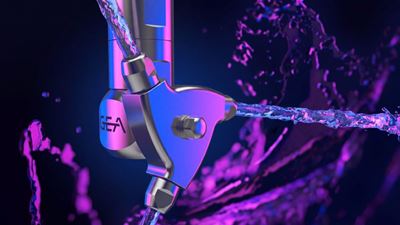
GEA is presenting GEA AdaptAx, a new generation of modular orbital cleaners designed for efficient tank cleaning, at BrauBeviale 2026 in Nuremberg, Germany. The new product platform combines up to 30 percent higher cleaning performance compared to the previous generation with a modular design that can be flexibly adapted to changing process requirements. (Photo: GEA, AI-generated)
„Built for change. Powered to clean.“
“Built for change. Powered to clean.” This guiding principle sums up GEA AdaptAx’s mission: to respond flexibly to changing process requirements while delivering high-performance cleaning. A GEA calculation model for a regional brewery with 50 fermentation and storage tanks illustrates the potential operational benefits. Each tank is eight meters in diameter and ten meters tall, with a capacity of approximately 500 cubic meters. An average of one cleaning cycle per tank per week adds up to 2,600 cleaning cycles per year. The model compares the existing cleaner with AdaptAx, using the same tank size and level of soiling and achieving comparable cleaning results. It assumes soiling class 4, the highest category, covering the most stubborn residues. Under these assumptions, cleaning time decreases from 60 to 45 minutes. At the same time, the volumetric flow rate drops from 100 to 80 cubic meters per hour, and the operating pressure falls from 10 to 8 bar.
Less water, wastewater, and cleaning chemicals
In the calculation example, the lower volumetric flow rate and shorter cleaning time reduce the total volume of liquid circulated per cleaning cycle from 100 to 60 cubic meters. Across 2,600 cleaning cycles, the difference of 40 cubic meters yields calculated water savings of 104,000 cubic meters per year. At facilities that dispose of all cleaning liquid after use, wastewater volumes decrease by the same amount. However, the circulated volume is not equivalent to freshwater demand when the liquid is recirculated or reused. In the model, cleaning chemical dosage is based on the circulated volume. Chemical use therefore also decreases by approximately 40 percent. With annual chemical costs of EUR 100,000, this represents calculated potential savings of approximately EUR 40,000.
53,560 fewer kilowatt-hours of pumping energy
The lower volumetric flow rate, lower operating pressure, and shorter cleaning time also reduce pump electricity consumption in the model. The existing cleaner consumes 39.7 kilowatt-hours per cleaning cycle, compared with an assumed 19.1 kilowatt-hours for AdaptAx. Across 2,600 cleaning cycles, the difference of 20.6 kilowatt-hours adds up to approximately 53,560 kilowatt-hours per year. At an electricity price of EUR 0.15 per kilowatt-hour, this represents savings of approximately EUR 8,000. Potential savings from heating the cleaning liquid and maintaining its temperature are not included: when less liquid needs to be heated, less thermal energy is required.
Adapt rather than replace
AdaptAx can also adapt to changing plant operating requirements. When breweries produce different products or increase or decrease production volumes, their cleaning needs may change. With conventional cleaning heads, a different tank geometry, a new product, or heavier soiling may require the unit to be replaced. This can entail additional investment, spare parts, and training. It may also be necessary to demonstrate again that cleaning meets the specified requirements—for example, through validation. GEA therefore designed AdaptAx as an expandable platform: operators can change nozzles, adjust operating parameters, and retrofit components while retaining the existing installation. “With GEA AdaptAx, we combine significantly higher cleaning performance with a modular platform that can adapt to changing process requirements. Our customers are investing not only in a powerful cleaning solution, but also in long-term flexibility and cost efficiency,” explains Christopher Lawton, Senior Product & Sales Manager at GEA.
Designed to reduce maintenance requirements
The design also aims to reduce maintenance and service requirements throughout the equipment’s operating life. Longer maintenance intervals, components less prone to wear, and easier access are intended to shorten planned downtime and reduce ongoing costs. In the calculation model, the interval between major maintenance activities increases from 500 to 1,000 operating hours. The assumed time required for each maintenance activity decreases from three hours to one hour. Over five years, spare parts costs are estimated at EUR 4,000 rather than EUR 8,000. The model puts maintenance labor costs at EUR 1,500 rather than EUR 3,000. Together, these figures yield calculated potential savings of approximately EUR 5,500 per cleaning unit over five years. Less frequent nozzle changes can also help prevent unplanned downtime.
Assess the model’s results for your own operation
The effects described are based on a calculation model and are not guaranteed performance figures. Actual results depend on factors including tank geometry, soiling, the cleaning program, system configuration, and operating parameters. Breweries and beverage manufacturers can enter their own CIP data into the model to assess the potential benefits for their operation.
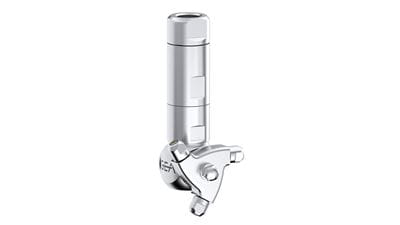
AdaptAX_100_Standard. (Photo: GEA)
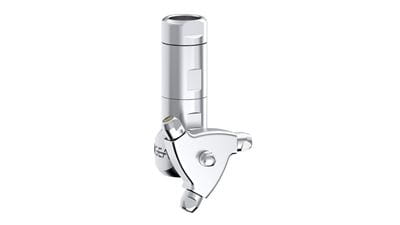
AdaptAX_150_Standard. (Photo: GEA)
GEA AdaptAx Live at BrauBeviale 2026
GEA will publicly unveil its new generation of modular orbital cleaners at BrauBeviale 2026, with the market launch planned for early 2027. During daily live demonstrations, GEA will showcase how AdaptAx can be easily serviced and flexibly adapted to different cleaning requirements by exchanging individual components.
Live demonstrations will take place daily at 11:00 a.m., 2:00 p.m. and 4:00 p.m. at the GEA booth in Hall 9, Booth 362. Additional demonstrations are available upon request.
Dates: November 10–12, 2026
Location: Messezentrum Nürnberg
GEA booth: Hall 9, Booth 9-362
Dr. Michael Golek
About GEA
GEA is one of the world’s largest suppliers of systems and components to the food, beverage and pharmaceutical industries.
The international technology group, founded in 1881, focuses on machinery and plants, as well as advanced process technology, components and comprehensive services. For instance, every second pharma separator for essential healthcare products such as vaccines or novel biopharmaceuticals is produced by GEA. In food, every fourth package of pasta or every third chicken nugget are processed with GEA technology.
With more than 18,000 employees, the group generated sales of about EUR 5.5 billion in more than 150 countries in the 2025 fiscal year. GEA plants, processes, components and services enhance the efficiency and sustainability of customers’ production. They contribute significantly to the reduction of CO2 emissions, plastic usage and food waste. In doing so, GEA makes a key contribution toward a sustainable future, in line with the company’s purpose: ”Engineering for a better world.”
GEA is listed on the German DAX, the European STOXX® Europe 600 Index and is also a constituent of the leading sustainability indices DAX 50 ESG, MSCI Global Sustainability and Dow Jones Best-in-Class World.
