
Keeping a production line running often depends on having the right spare part at exactly the right moment. Whether producing dairy products, beverages, pharmaceuticals or other essential goods, manufacturers rely on equipment that performs when needed. That's the challenge GEA's Global Parts Center (gPAC) was designed to solve. The center is a highly automated separator, decanter, valve and pump service platform that brings together spare parts, logistics and service expertise to help customers keep production running smoothly in today’s fast-moving and unpredictable production environment.
A new kind of logistics hub
In northern Germany, GEA's gPAC presents a very different image from the traditional logistics warehouse. Rooftop solar panels, living green facades and extensive landscaping surround the facility. Inside, robots quietly go about their work. Every part has a digital identity. Complete maintenance kits are assembled in advance. Urgent orders have their own fast lane. And these aren't just nuts and bolts; the facility handles everything from oversized parts and fragile glass components to UV-sensitive seals and hazardous materials.
The speed to meet the moment
“Modern manufacturing has become a remarkable balancing act,” says Hendrik Waltz, Vice President, Service Supply Chain at GEA. “Producers are expected to become faster, leaner and more sustainable while navigating labor shortages, volatile supply chains and an increasingly competitive global marketplace. As a result, there is a new generation of highly automated production facilities where every process is carefully optimized. And yet an entire production line can still be stopped by something as ordinary as a worn seal, a failed valve or a damaged sensor.” Downtime is more costly than ever, and fast, reliable access to spare parts has become business critical. The Global Parts Center is GEA's answer. Developed in partnership with global logistics company Kuehne+Nagel, the facility brings together GEA's deep understanding of industrial service with Kuehne+Nagel's expertise in operating complex logistics networks.
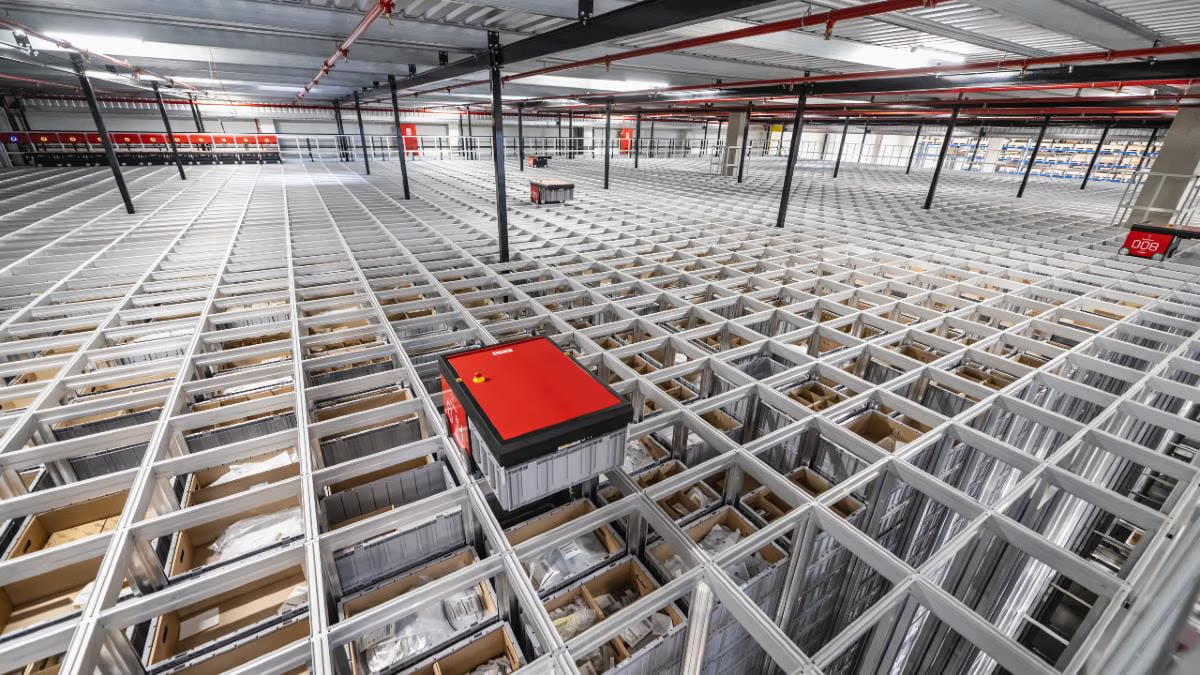
Inside, a vast three-dimensional storage grid dominates the space. Its surface is alive with robots moving silently from one location to the next. Beneath them, nearly 30,000 different spare parts are stored in tens of thousands of containers – all part of the AutoStore concept at the heart of the operation. “The AutoStore was specifically designed around GEA's operational requirements,” explains Christian Brüseke, Area Contract Logistics Manager at Kuehne+Nagel. “Combined with digital warehouse management and round-the-clock standby support, it allows us to keep nearly 80 percent of GEA's spare parts portfolio available for centrifuges and flow components for rapid retrieval whenever customers need it.”
Frequently requested components remain close to the surface for rapid retrieval, while slower-moving inventory is stored deeper within the grid, maximizing storage density without compromising availability. Fast lane processes allow urgent orders to bypass normal storage workflows altogether, moving directly from receiving to shipping with direct handover to a dedicated express delivery service. “Behind every shipment is a highly coordinated operation that brings together inventory, automation and logistics in real time,” Jan Hühnlein says, Senior Project Manager, Service Supply Chain, GEA. “That's what gives us the speed and precision we need today, while providing the scalability to grow with our customers' needs.”
Location also plays a crucial role. Situated close to Hannover Airport and the Autobahn A2 and A7 in Sehnde, Germany, the gPAC combines late order acceptance with rapid access to parcel and air-freight networks. As a result, orders placed later in the day can still be dispatched that same evening, reducing response times for customers when their production cannot wait. "From here, we can deliver spare parts to our customers faster than ever before," Waltz says.
“In effect, we aren’t simply packaging parts – we are packaging maintenance knowledge.”
Jan Hühnlein
Senior Project Manager, Service Supply Chain, GEA
Speeding up maintenance, not just delivery
The gPAC reimagines the way spare parts are delivered – but also the way they're installed. Drawing on decades of field experience, GEA assembles frequently required maintenance components into ready-to-ship service kits. “In effect, we aren’t simply packaging parts – we are packaging maintenance knowledge,” Waltz says. Instead of sourcing dozens of individual seals, bearings, gaskets and fasteners, technicians receive exactly what they need in a single package. Everything arrives together, reducing the risk of missing parts, simplifying planning and helping maintenance work get underway without unnecessary delays. The result is a service model designed not only to move parts faster, but to help customers return equipment to operation faster.
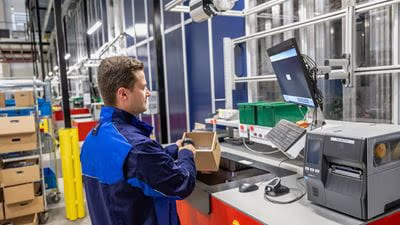
Once delivered by the robot, an employee checks the spare parts against the order in the system and prepares the shipment for the customer. (Image: GEA)
From many warehouses to one connected service hub
“The fastest shipment in the world still creates friction if customers have to place three separate orders to get it,” Hühnlein notes. Many GEA customers operate production lines that combine separators, decanters, pumps, valves and other technologies. In the past, replacement parts for those systems could originate from different warehouses, resulting in multiple orders, shipments and delivery schedules. Today they can be consolidated, processed and shipped from a single global hub in Sehnde.
“Speed is important, but we also want to reduce complexity,” Hühnlein says. “Our customers increasingly operate integrated production lines built around multiple GEA technologies. Bringing spare parts together in one location allows us to simplify the entire service experience. Instead of juggling multiple deliveries, customers have one point of contact and one reliable source.”
“The gPAC doesn't simply move components – it helps customers extract more value from the equipment they already own. We look at sustainability across the entire service model – from how parts are stored and transported to how maintenance is planned and carried out.”
Hendrik Waltz
Vice President, Service Supply Chain, GEA
Sustainability by design
Along with efficiency, sustainability was a guiding principle in the design of the gPAC – from renewable electricity and rooftop solar panels to heat pumps, green facades and a German Sustainable Building Council gold certification. But gPAC’s greatest sustainability contribution is its core mission: helping existing equipment remain productive for longer. Every spare part delivered at the right time can help avoid unnecessary downtime, extend equipment life and postpone premature replacement. “The gPAC doesn't simply move components – it helps customers extract more value from the equipment they already own,” Waltz says. “We look at sustainability across the entire service model – from how parts are stored and transported to how maintenance is planned and carried out.”
Thinking beyond the machine
The gPAC is the physical expression of a broader shift in GEA's approach to customer service. By combining automation, digital intelligence and decades of service expertise under one roof, GEA is redesigning the entire service experience – from ordering and maintenance planning to installation and long-term support. Few projects illustrate GEA's Better Journey: Think Better. Build Better. Run Better. philosophy more clearly. “Designing, building and commissioning world-class equipment is only part of the challenge,” says Waltz. “Keeping that equipment operating efficiently, reliably and sustainably over decades is equally important. The gPAC is part of the infrastructure that enables customers to run better, bringing together digital technologies, automation and service expertise into a platform that supports long-term operational performance.”
gPAC by the numbers
30,000
The AutoStore advantage
The technological heart of the gPAC is a fleet of autonomous robots retrieving spare parts from a densely packed three-dimensional storage grid housing nearly 30,000 different items – for faster throughput, high inventory availability and rapid response to customer orders.1m
One million order lines
The gPAC assembles up to 120,000 shipments per year, processing around 1 million individual order items with around-the-clock operational readiness.100%
Designed for sustainability
Powered by 100% renewable electricity, the Global Parts Center (gPAC) combines rooftop solar panels, air-to-water heat pumps, LED lighting, green roofs and facades, 40,000 m² of landscaped green space, and DGNB gold certification.20,000
