
GEA is highlighting how glass producers can recover energy from hot furnace exhaust gases while meeting demanding emissions requirements. At glasstec 2026, the company will present integrated systems that combine waste heat recovery with the removal of sulfur oxides, nitrogen oxides and dust. Glass melting generates a continuous stream of high-temperature exhaust gas. Instead of allowing this thermal energy to leave through the stack, GEA waste heat recovery units transfer it to another medium for reuse as process heat or for power generation. This can reduce external energy demand and improve the overall energy efficiency of the plant.
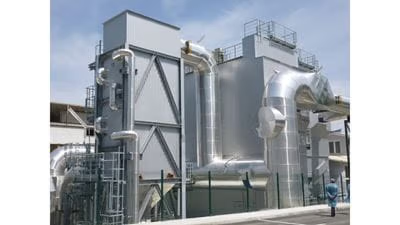
Emission control plant for glass manufacturing, including a waste heat recovery unit. (Photo: GEA)
Energy recovery designed around each furnace
The recoverable energy depends on exhaust gas temperature, volume flow, operating hours and the way the system is integrated into production. GEA adapts each solution to these parameters and to the site’s emissions profile. Heat recovery can be supplied as a stand-alone system or combined with desulfurization, catalytic denitrification and dust removal.
One option is to connect the recovery system to an Organic Rankine Cycle. Thermal oil transfers heat from the exhaust gas to an organic working fluid, which evaporates and expands through a turbine to generate electricity. The power can be used on site, reducing the amount purchased from the grid.
Commissioned projects demonstrate industrial demand
Several recently commissioned GEA systems are now recovering energy from continuously available process gases in new and existing plants. The projects reflect growing interest among manufacturers in using waste heat as an energy source within their own operations.
“The continued order intake and the successful commissioning of recent projects show that waste heat recovery is becoming an increasingly relevant part of industrial energy strategies,” says Jens Lange, Senior Director Sales Industrial, BL Environmental at NPE BU ProTech “Our role is to develop a robust solution around each customer’s process and make recovered energy reliably available for reuse.”
Explore glass emission control in an interactive process line tour
A new interactive process line tour by GEA provides further insight into flue gas treatment for glass manufacturing. Customers can explore the individual process stages, available technologies and system configurations for emission control and energy recovery. The online tour also shows how the components can be combined to meet plant-specific requirements.
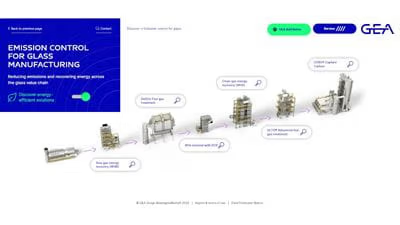
The interactive process line tour shows how emission control and energy recovery technologies can be combined to meet plant-specific requirements in glass manufacturing.
Dr. Michael Golek
About GEA
GEA is one of the world’s largest suppliers of systems and components to the food, beverage and pharmaceutical industries.
The international technology group, founded in 1881, focuses on machinery and plants, as well as advanced process technology, components and comprehensive services. For instance, every second pharma separator for essential healthcare products such as vaccines or novel biopharmaceuticals is produced by GEA. In food, every fourth package of pasta or every third chicken nugget are processed with GEA technology.
With more than 18,000 employees, the group generated sales of about EUR 5.5 billion in more than 150 countries in the 2025 fiscal year. GEA plants, processes, components and services enhance the efficiency and sustainability of customers’ production. They contribute significantly to the reduction of CO2 emissions, plastic usage and food waste. In doing so, GEA makes a key contribution toward a sustainable future, in line with the company’s purpose: ”Engineering for a better world.”
GEA is listed on the German DAX, the European STOXX® Europe 600 Index and is also a constituent of the leading sustainability indices DAX 50 ESG, MSCI Global Sustainability and Dow Jones Best-in-Class World.
