
Rethinking Beverage Production with GEA NEXUS

Heat wasted on the roof, excessive use of harmful and expensive chemicals, water flushed down the drain, fuel burned by old-fashioned boilers… Wake up, it’s 2023! We really don’t need that anymore. These days there’s a way to get rid of bad habits from the past and to organize your beverage factory in a much more sustainable way. The juicy truth behind the magic lies in… letting our experts in Holistic Engineering Solutions (NEXUS - Integrated process and cooling & heating solutions) join forces and sink their teeth into your challenges. We had a chat with two of GEA’s brightest minds who love doing just that: Franz-Josef Helms, beverage process expert, and Robert Unsworth, cooling and heating expert.
Why are you introducing the NEXUS approach to beverage customers?
Robert Unsworth: “Traditionally, a process plant is designed in two separate parts, where process and utilities (cooling & heating) are not looked at as a whole. People tend to focus so hard on the design or optimization of a particular process that they overlook the bigger picture. We see that a lot when we talk to beverage plant owners around the world. What we try to do is bring these two parts together and ensure they work well together. Just like we do here within GEA.”
Franz-Josef Helms: “Exactly. You see, it’s all about breaking with old patterns. GEA has the unique advantage of having in-house knowledge of both process and utilities. We work closely together and that’s what we try to make our customers do too. We know it isn’t always easy because they’re faced with the reality that the road to expansion and development is often paved with interdisciplinary demands and conflicting requirements. And, unfortunately, this means that many opportunities are missed.”

GEA experts Robert Unsworth (left) and Franz-Josef Helms(right)
And when you keep the bigger picture in mind, you can make the most progress?
Robert Unsworth: “That’s right. If a facility can get us (I mean utilities) in as early as possible in the design process, there’s less likely to be any fallout later, because it means the solution will be more closely aligned with expectations from a very early stage. And it will be cost-effective. When the refrigeration and processing teams are striving towards a common goal (i.e. significant cost- and energy-savings), then the most amazing transitions can be achieved. We’re living proof of that, aren’t we, FJ?”
Franz-Josef Helms: “Yes, when you put process knowledge and cooling & heating knowledge together, you’re not talking about gaining 0.5% here and 1% there. It’s not about small steps such as changing a specific piece of equipment or setting a parameter correctly. With our holistic approach – NEXUS – it’s possible to help reduce energy use and operating costs while also supporting reductions in CO₂ and NOx emissions. When this is combined with opportunities to reduce water and chemical consumption and product losses, the overall plant can make meaningful progress towards its sustainability goals.
Those figures are pretty impressive. Do they extend to all beverage applications?
Franz-Josef Helms: “Definitely. That’s the beauty of it. Our holistic approach works for any application in any size of project. It doesn’t matter whether you have a greenfield or brownfield project, or whether you need a certain temperature to brew beer or another temperature to pasteurize juice.”
Robert Unsworth: “Absolutely. Because you can actually think of every beverage factory as a massive refrigerator. Anything that goes on in there generates warmth, or heat. And heat is energy. So instead of letting that heat go to waste and actually paying to dump it, we look for ways to recover it and reuse it elsewhere in the process. You can often find that a GEA heat pump plays an important role in the overall system.
Look, heat pumps have been used for homes and district heating for a long time, but not actually that long in industry. That’s because the food, beverage and dairy industry needs higher temperatures. GEA has put a great deal of effort into developing heat pump technology in recent years. As a result, temperatures of up to 90°C and above can now be achieved, making high-temperature heat pumps an option for many beverage processes. On top of that, customers who install a GEA heat pump will reduce their reliance on fuel-fired boilers, which are often used for heating water. Depending on the application and system design, this can help improve energy efficiency and reduce associated CO₂ emissions. Using electricity from renewable sources, such as wind power, can further reduce the associated emissions.”

NEXUS make sense for all beverage applications
Wasn’t that exactly what innocent did at its new juice manufacturing plant in Rotterdam (the Netherlands)?
Robert Unsworth: “Yes, innocent’s new facility in Rotterdam is of course a great example and we’re incredibly proud of that. You can read all about it in an article on the GEA website , but the point I’d like to make here is that innocent has approached this particular project with an open mind right from the start and has teamed up with like-minded partners who share its vision of creating a planet-friendly, human-friendly and cost-effective factory. The new plant fully exploits smart GEA technologies for directly and indirectly recovering energy from one part of the process and channeling it to other parts of the plant, with a little ‘smart buffering’ in between. And besides energy recovery, a lot of effort went into cutting down water and chemical consumption and reducing the loss of raw materials and product.”
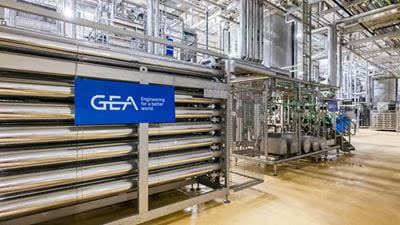
GEA juice thermal treatment system powered by GEA heat pump technology
The impact on the Total Cost of Ownership is significant, and the influence on the environment is huge.
Robert Unsworth: “That’s right. And there’s a massive need for that now, worldwide. According to the IEA [Energy Efficiency, 2024], accelerating energy efficiency improvements can deliver more than one-third of the CO₂ emissions reductions needed between now and 2030 in a pathway aligned with net zero emissions by 2050. So our responsibility as industrial players as to whether or not we succeed in achieving the standards is enormous.” Read the report

GEA refrigeration and heat pump plant
And, uh, is a switch to Holistic Engineering Solutions expensive?
Robert Unsworth: “Not if you think it through early enough! You might need a heat pump, but depending on the system design, you may be able to reduce or eliminate the need for a separate boiler or condenser in the refrigeration plant. Though you’ll probably need a thermal buffer, so the overall investment can be broadly comparable, perhaps a little higher. Here, too, the golden rule applies: look at the bigger picture. Although you may require slightly more capital investment, the potential for lower operating costs can help deliver an attractive payback.”
So what you’re actually saying is that beverage manufacturers can make significant progress towards lower-carbon production?
Robert Unsworth and Franz-Josef Helms: “That’s exactly the point we’ve been trying to make.” (both laugh)

