
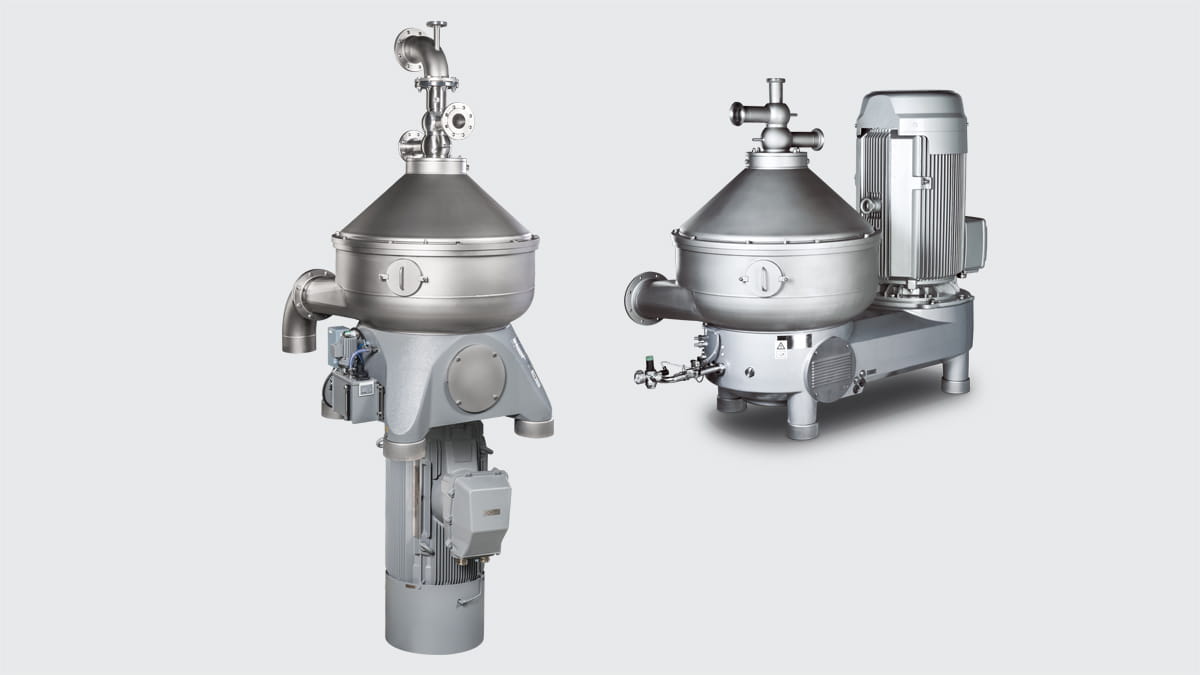
Our nozzle separators are of course CIP-capable, on-top they are designed for highest capacity, lowest energy consumption and reliable operation. The optional direct drive makes for higher capacities with the same energy input, lower noise level and smaller footprint.
Furthermore, replacing a nozzle is only a matter of minutes as they are easily accessible and replaceable through a duct from the outside: a dismantling of the hood or the bowl is not necessary. They are locked in place automatically and help save energy due to the way the product discharge is oriented: opposite to the direction of the bowl's rotation.
What is a starch separator?
A starch separator is a high-speed disk-stack centrifuge that uses high g-force to separate starch granules from water, fibers, proteins and other dissolved substances. In industrial starch processing, GEA nozzle separators are the standard solution because they can handle high volumes and have a very high separation efficiency.
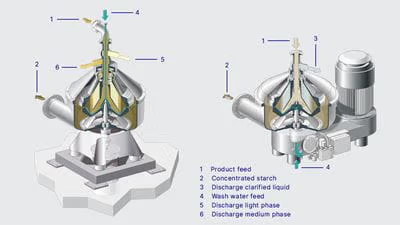
Working principle of a 2-phase and a 3-phase nozzle separator for starch concentration and washing
What are the main applications of starch separators?
GEA nozzle separators are used across the food industry wherever starch must be recovered, washed or concentrated, and corn gluten must be thickened. Typical applications include wheat starch, corn (maize) starch, potato starch, tapioca starch, rice and pea starch productions.
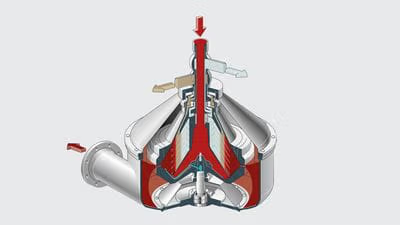
How does a GEA separator for starch recovery work?
The product enters the bowl, is accelerated and passes into the disk-stack, where centrifugal force separates the starch particles from the liquid. The narrow gaps between the disks reduce the settling distance and provide a large clarification area.
Features & Benefits of GEA starch separators
- Excellent process water quality minimizing fresh water consumption
- Continuous and stable feed to the HC unit for uncomplicated washing
- Closed feed and discharge prevent foaming and make for a more stable overall production process
- Low energy consumption because of modern drive concepts, special nozzle configuration and reduced bowl weight
- Automatic CIP included
- No additional pumps for the liquid phase because of internal centripetal pump
- Fast and easy maintenance due to excellent access to the nozzles
Extra advantages of starch separators with direct drive
- Higher capacity with same energy input
- Retroactive capacity adjustments by using different motor sizes
- Reduced service efforts (no gearbox, coupling replacement is direct and simple)
- No belt tensioning
- Only very little space required due to small footprint
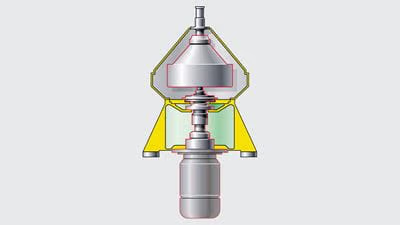
Starch separators with direct drives
More performance, less complexity
GEA’s separation expertise and portfolio for starch recovery
Depending on the specific feedstock, i.e. wheat, corn, rice etc., GEA offers disk-stack nozzle separators in 2-phase or 3-phase design, with or without integrated wash water systems, with flatbelt or direct drive.
Our expertise covers not only single machines but the entire wet process engineering, including rotary brush strainers, pumps, valves, control cabinets, piping and the entire skid production process—from design and drafting to planning and completion.
Apart from nozzle separators GEA also offers self-cleaning separators for process water clarification and decanter centrifuges for dewatering or separation purposes.
How does the GEA nozzle separator compare to other starch separation technologies?
|
Technology |
Primary job |
Where it fits |
|
Nozzle separator (GEA) |
Continuous washing & concentrating of starch; corn gluten thickening |
Main workhorse in industrial starch processing |
|
Clarifying decanter |
Dewatering of solids with higher solids content |
Sludge / fiber-rich streams, pre- or post-stages |
|
Hydrocyclone (HC) unit |
Multi-stage countercurrent washing of starch |
Fine washing between separator stages |
|
Disk-stack clarifier |
Polishing / removing fine solids from low-solid streams |
Process water clarification |
Nozzle separators and hydrocyclones are typically used together: the separator concentrates, the HC unit washes, on top GEA nozzle separators make for a continuous, stable feed to the HC unit.
Capacity & Technical Specifications
GEA nozzle separators cover a rated feed flow capacity of 20 to 400 m³/h, allowing the machine to be sized precisely to each starch separation stage, from corn gluten thickening to primary starch concentration in large-scale plants.
Direct-drive separators can easily be equipped with motors of different sizes, making the separator suitable for a wider range of throughput capacities and starch concentrations.
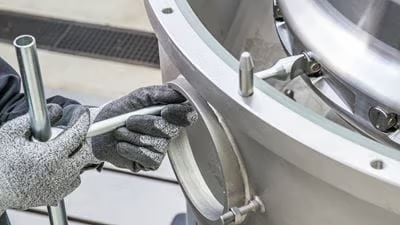
Easy access for fast nozzle replacement
The bowl is designed for high g-force and continuous nozzle discharge, with nozzles accessible from the outside through a duct for fast replacement. The nozzles are locked in place automatically and help save energy due to the way their product discharge is oriented: opposite to the direction of the bowl's rotation.
Drive options include a belt drive and an optional direct drive. Product-contact parts are built for hygienic operation in food processing and are CIP-capable.
How is the separator cleaned and maintained?
The separator is fully CIP-capable. During the automatic CIP cycle, the bowl is sped up to maximum speed to create a ring of CIP liquid inside the bowl. The speed is then reduced which causes the liquid ring to collapse. This leads to high splashing and turbulence so that every corner and every spot is wetted and thus cleaned.
GEA offers regular drive and bowl maintenance through its International Service and Repair Network.
What service and support does GEA provide?
GEA supports the full lifecycle of every nozzle separator through its International Service and Repair Network, original spare parts, performance upgrades, automation & controls packages, and Remote Factory Acceptance Tests (Remote FATs). On-site service and condition monitoring help maintain availability over the long service life of the machine.
Our portfolio of digital products for centrifugal separators and decanter centrifuges delivers a connected ecosystem of monitoring, optimization and service solutions.
Combining equipment data, advanced analytics and expert support, our digital solutions enable higher transparency, faster decision-making and continuous operational improvement.
With our 24/7 monitoring solution for your GEA separators and decanters - GEA InsightPartner® Separation Monitoring - you benefit from early issue detection, automated analysis and expert remote support for increased availability, reliability and efficiency.
Frequently Asked Questions about nozzle separators from GEA for starch recovery
The required capacity depends on raw-material throughput, the number of washing stages and the target starch quality. GEA sizes each separator individually based on your mass balance, request a quote for a stage-by-stage recommendation.
Because the nozzles are accessible through an external duct in the catcher you do not have to dismantle the hood and all the piping. Thus, nozzle exchange is relatively fast compared to other starch separators without ducts.
GEA nozzle separators are designed for long service life under continuous industrial operation. The lifetime can be extended significantly through original spare parts and regular service inspections from GEA's International Service and Repair Network.
Yes. GEA offers upgrade packages, updated automation & controls, and refurbishment through its International Service and Repair Network, designed to improve capacity, energy efficiency and uptime on installed equipment.
Downloads
Related Products

Clarifying Decanters for Starch Recovery
For starch recovery clarifying decanters are installed in different process stages depending on the raw material.

Automation & Controls Separation
Even the best centrifuges cannot function optimally if they are not partnered with control systems of equal quality. For their range of separators and decanters, GEA offers standardized as well as tailor-made solutions for machine automation with many features to meet customer requirements.

3-phase wheat starch decanters
GEA starchmaster CF decanter series for the extraction of wheat starch - efficient, robust, yield-optimized
Service Products

International Repair Network for GEA Centrifuges
Corrective repairs for your GEA separators and decanters

Remote FATs for GEA Centrifuges
Is a FAT (Factory Acceptance Test) of your centrifuge not possible on site due to current travel restrictions, a very tight schedule or other urgent reasons? Are you generally looking for ways to make business processes more digital and to sustainably reduce costs and time?
Here, too, we are at your side with the professional quality you are accu...
Related Videos
Let’s get connected – digital solutions for GEA centrifuges
Let’s get connected – digital solutions for GEA separators and decanters
Stay stronger with GEA Service Level Agreements
GEA Insights
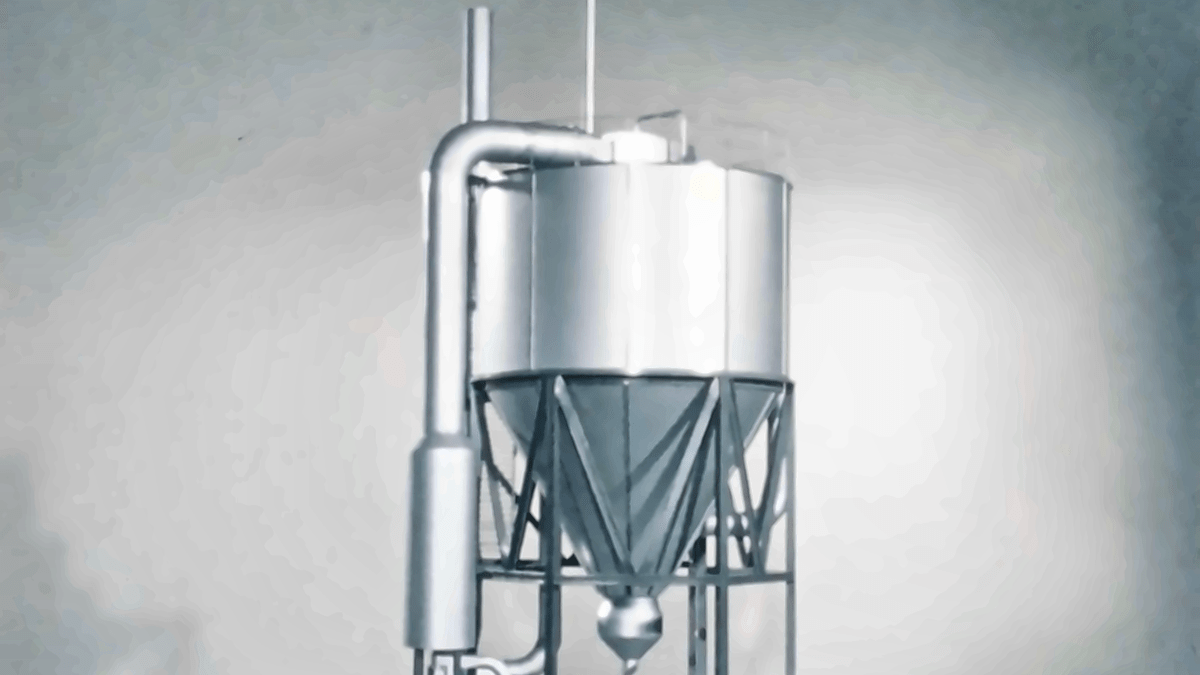
The breakthrough that changed spray drying
In 1976, NIRO engineers responded to a competitive challenge by rethinking what spray drying could do. Their idea became the multi-stage dryer MSD. Fifty years later, the same fundamental principle helps turn liquids into the powders used in essential nutrition products and important medicines around the world. Refined through decades of engineering expertise, customer insight and continuous development, MSD is a story of innovation with lasting impact.

Beyond the machine: unlocking better plant performance
An efficient machine does not automatically make an efficient factory. Real improvement often starts by looking beyond individual equipment and understanding how processes, energy systems and operating decisions affect one another. It’s a holistic approach designed to uncover opportunities that might otherwise be missed.

How a valve reshapes the way food and drinks are made
In food and beverage plants, valves are commonly operated using compressed air. GEA Hydract® Actuation Technology moves valves with water instead, in a closed, digitally controlled circuit. The result is a valve that can be held exactly in place and steered in fine-tuned steps. This results in lower energy use and greater control.
