
-
Production is part of the equation: Whether heat pumps and waste heat recovery work technically and pay off economically depends on temperature levels, load profiles and the scope for process changes.
-
Decisions that hold up in the long run: GEA assesses technical options, operating costs and risks, and sequences measures for the next 10 to 15 years.
-
Project experience: GEA has developed and implemented energy and decarbonization concepts for breweries and beverage producers.
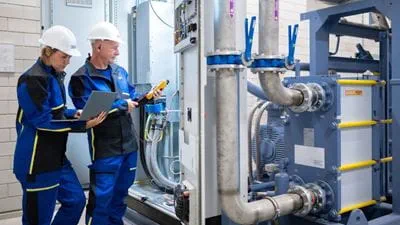
Refrigeration plants release waste heat. A heat pump can make this heat usable for the brewery. Image: GEA
Many beverage manufacturers are looking into heat pumps, waste heat recovery or switching from steam to hot water. But whether these measures work technically and pay off economically is not decided in the utility plant alone. Production processes also play a decisive role: when heating and cooling are needed, at what temperatures, and which modifications are possible while production keeps running.
At BrauBeviale, November 10–12, 2026, GEA will present its Add Better Consulting service in Hall 9, Booth 9-362. The team analyzes a plant’s production processes, heat supply and refrigeration together, looking at existing equipment, load profiles and energy flows. This makes it possible to compare technical options, assess their impact on production, CO₂ emissions and operating costs, and plan investments for the long term.
Single measures fall short
A brewery needs heat, but it also has to cool. Cooling generates waste heat that, under certain conditions, can be put to use elsewhere in the plant. For this to work, energy supply and production have to match: What temperatures does the process really need? When is waste heat available, and when is it needed? And which changes are possible without compromising quality, hygiene or throughput? In the GEA team’s experience, technical design data is often not enough to answer these questions. What matters is how the equipment runs day to day and how the systems affect each other.
The team brings together specialists in brewing technology, production processes, and heating, cooling and energy engineering. They combine operating data and measurements with their knowledge of waste heat recovery and of implementing changes in existing plants.
“A heat pump on its own isn’t the right solution for every operation. Only when we look at production and energy supply together can we see what works at a given site,” says Dr. Isabel Osterroth, Senior Director Add Better Consulting & Nexus at GEA.
Technically feasible is not automatically economically viable
Heat pumps can play a central role in energy concepts. Whether they are economically viable depends on infrastructure and production processes, but also on the ratio of electricity to gas prices.
In a brewery project Osterroth supported, a refrigeration plant used to release its waste heat into the environment at around 35 °C. Today, a heat pump raises this waste heat to 90 °C. This allows the brewery to cover up to 45 percent of its total heat demand. Under suitable site and process conditions, this approach can cover up to 100 percent of heat demand.
“A solution can be technically sound and still not pay off. That’s why we look at the whole bill: what the system costs to buy, what it costs to run and how much we have to intervene in production,” says Osterroth. For each site, the team compares several options and assesses investment requirements, operating costs and operational risks.
A plan for the next 10 to 15 years
The analysis looks beyond the next investment: How will the plant meet its heating and cooling needs in the future? Will it add new lines? Which of today’s decisions will shape the options available later?
“We check which of today’s decisions make later conversions easier and which make them unnecessarily expensive,” says Osterroth. If a conversion will only pay off in a few years, the company can already plan for the retrofit today.
The result is a prioritized roadmap based on an analysis of the existing plant, feasibility studies and an economic assessment. On request, GEA also takes on further planning, implementation and support during operation. TÜV Rheinland has validated the Add Better Consulting process, including its methodology.
Hands-on workshop at BrauBeviale
“Where does your energy really go?” – November 11, 2026, 3:30–5:00 p.m., Focus Corner, Hall 9, Booth 9-626, with Dr. Isabel Osterroth and Julius Jung.
Fanny Foerster
Find out more
About GEA
GEA is one of the world’s largest suppliers of systems and components to the food, beverage and pharmaceutical industries.
The international technology group, founded in 1881, focuses on machinery and plants, as well as advanced process technology, components and comprehensive services. For instance, every second pharma separator for essential healthcare products such as vaccines or novel biopharmaceuticals is produced by GEA. In food, every fourth package of pasta or every third chicken nugget are processed with GEA technology.
With more than 18,000 employees, the group generated sales of about EUR 5.5 billion in more than 150 countries in the 2025 fiscal year. GEA plants, processes, components and services enhance the efficiency and sustainability of customers’ production. They contribute significantly to the reduction of CO2 emissions, plastic usage and food waste. In doing so, GEA makes a key contribution toward a sustainable future, in line with the company’s purpose: ”Engineering for a better world.”
GEA is listed on the German DAX, the European STOXX® Europe 600 Index and is also a constituent of the leading sustainability indices DAX 50 ESG, MSCI Global Sustainability and Dow Jones Best-in-Class World.
