

For a pregnant woman receiving essential supplements through a local health program, one small tablet, taken daily, is a given. She rarely stops to think about how it got into her hand. Behind it is a chain of people she will never meet: the operators who run each batch, the quality teams who document every step and the auditors who check that the label matches the tablet contents. Her confidence in that tablet rests on that chain. For millions of women, the essential vitamins and minerals in that tablet can help their baby arrive at a healthy weight. That is why, for Beta Pharmacon, each batch is more than a production result. It is a promise to a mother.
During pregnancy, the body’s need for vitamins and minerals increases. Yet, for many women, particularly in low- and middle-income countries, diet alone may not provide all the micronutrients needed to support maternal health and fetal development. Multiple micronutrient supplements (MMS) help to close this gap. Compared with iron and folic acid alone, MMS can reduce the risks of low birthweight and babies being born small for gestational age.

The standardized U.N. International Multiple Micronutrient Antenatal Preparation (UNIMMAP) formulation, developed by UNICEF, the World Health Organization and the U.N. University, contains 15 essential vitamins and minerals, including iron and folic acid. Because these supplements are taken by millions of pregnant women and often supplied through international health programs, manufacturers must meet some of the industry’s most stringent quality requirements.
The US Pharmacopeia (USP) UNIMMAP MMS Verification Program supports access to trusted quality prenatal supplements by evaluating whether manufacturers comply with the program’s requirements and UNICEF product specifications. Beta Pharmacon, part of Indonesia’s Dexa Group, is one company that has completed this verification.
The challenge
The company set out to build a world-class solid-dosage manufacturing facility for domestic and international markets. Its strategic vision was clear: produce branded and generic pharmaceutical products at high volume, across multiple therapeutic categories, and to the highest international regulatory standards.

Entering global pharmaceutical supply chains, particularly those serving humanitarian programs, requires manufacturers to demonstrate not only quality intent but measurable, auditable quality performance. Advanced, reliable equipment minimizes process variability and supports smoother audits by international regulatory bodies. Beta Pharmacon needed process technology that would
- deliver consistent batch-to-batch granulation performance across a diverse product portfolio
- support good manufacturing practice (GMP) certification and agency inspections
- scale efficiently for high-volume output without compromising product quality
- provide a robust foundation to satisfy the qualification requirements from all partners.
Meeting these requirements depended heavily on the process machinery itself because batch consistency, audit readiness and scalability are all shaped by the technologies in the production facility. Any partner’s equipment would be assessed against each of these criteria before committing.
Selecting the right partner
The collaboration began in 2022–2023 when Annes Patricia, GEA Regional Sales Director, supported Beta Pharmacon in evaluating technology providers for its new solid-dosage manufacturing facility. A key milestone was a visit to GEA India’s manufacturing site, organized by Patricia, where Beta Pharmacon’s team could assess engineering quality, manufacturing standards and technical capability firsthand – not through brochures, but through direct observation and discussion.
"For our new production facility, we required equipment that provided greater process control and enabled digital data acquisition. Visiting the GEA facility assured us that the technology behind the machines matched the standards we were aiming for," says Gatot Prayitno, Director at Beta Pharmacon.
Preparing for qualification
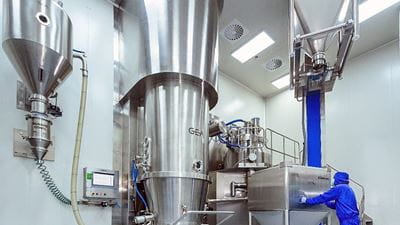
Following the evaluation process, GEA was engaged to supply two 1,200 L integrated granulation lines. Rimal Patel, Sales Director, Pharma Oral Solid Dosage (OSD), APAC, provided extensive technical and commercial consultation, helped Beta Pharmacon identify process challenges and subsequently recommended tailored solutions. Designed for robust, repeatable wet granulation in demanding pharmaceutical environments, the high-capacity systems provided the scale, process reliability and engineering quality that the company’s ambitions required. Installation was completed in 2024, and the facility achieved GMP certification in 2025.
The production lines are designed to support generic products such as antidiabetic, cardiovascular, anti-inflammatory and pain-relief indications. Following GMP certification from local and international regulatory authorities, Beta Pharmacon underwent a rigorous qualification audit to produce a much-needed MMS for both local and global supply. They passed the audit and were approved.
“Achieving USP qualification for MMS supply and meeting the stringent qualification requirements is a landmark moment – not only for us but also for Indonesian pharmaceutical manufacturing. It demonstrates what is possible when vision is matched with the right technology," says Astuti Dewi Atmisari, Head of Quality at Beta Pharmacon.
Earning USP verification
The successful qualification demonstrates Beta Pharmacon’s commitment to international manufacturing standards, process reliability and quality excellence. This achievement positions the company as one of a small number of USP-verified suppliers for this program. Although several factors contributed to the achievement – including facility design, operational readiness and quality systems – the investment in advanced processing technology played an important role by supporting consistent manufacturing performance and regulatory confidence.
Tech talk: Pharma glossary

Good manufacturing practice (GMP)
A system of quality assurance regulations that ensures pharmaceutical products are consistently produced and controlled to high-quality standards.
Granulation
A process during which primary powder particles are blended and adhered to form larger, multiparticle entities called granules.
Overall equipment effectiveness (OEE)
A measure of how well manufacturing equipment is utilized compared with its full potential.
Oral solid dosage (OSD)
Pharmaceutical drug products manufactured in a solid form that are taken by mouth, swallowed and absorbed through the gastrointestinal tract.
U.S. Pharmacopeial Convention (USP)
An independent, nonprofit scientific organization that sets public quality, purity, strength and identity standards for medicines. “USP” refers to both the organization and its book of standards.From manufacturing excellence to global impact
Beta Pharmacon’s success shows how strategic investment in advanced pharmaceutical process technology can do more than optimize manufacturing metrics. It can open doors to global health programs and position an emerging-market manufacturer as a partner of choice for the world’s most demanding supply networks.
For GEA, the partnership reflects a shared commitment to raising pharmaceutical manufacturing standards and helping customers participate in critical healthcare initiatives wherever they are needed. “Beta Pharmacon's achievement is a powerful example of what world-class process technology can unlock. We are proud to have played a part in supporting their journey to global qualification,” says Raman Singh, GEA Vice President Country Manager, Pharma & Food Applications, India Cluster.
